Loading
Fiber Testing, Analysis & Optical Commissioning
From the field to the network, NodalWire turns test data into engineering insight, so you can accept with confidence, repair what matters, and put your network into service.
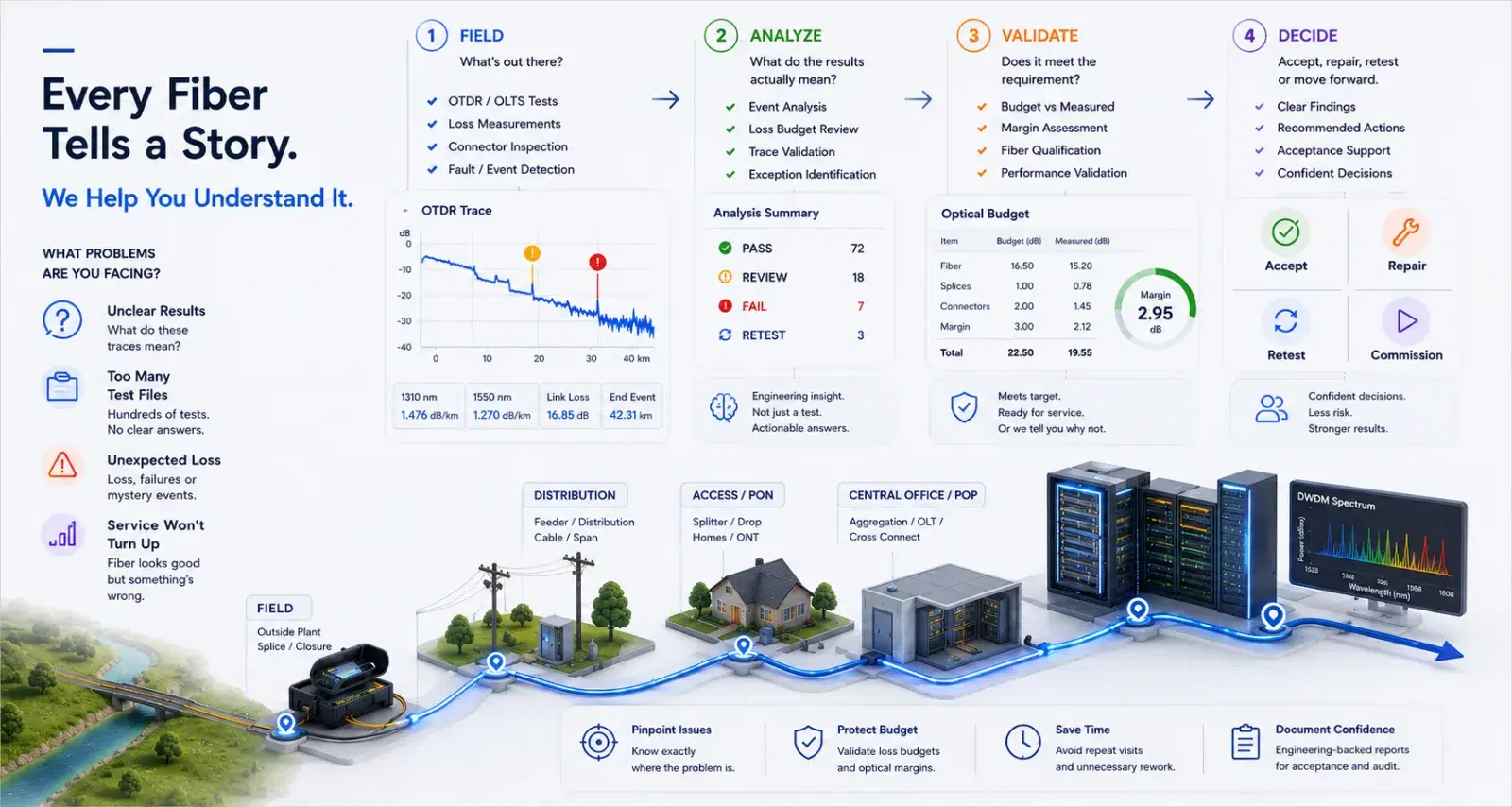
What problems are you facing?
You have traces and reports, but not an answer. What do they actually mean?
Hundreds of tests from a contractor package. No clear picture of what passed and what did not.
Fibers are failing, degrading, or showing events that need investigation.
The fiber looks fine, but the optical service still is not performing correctly.
How An Engagement Works
Not every project needs every measurement. Scope follows what the fiber has to carry and the decision you are trying to make.
What is out there?
What do the results actually mean?
Does it meet the requirement?
Accept, repair, retest, or move forward?
What You Get Back
An illustration of the outputs from a typical acceptance review. Actual deliverables are scoped to the engagement.
Events flagged for review, one high-loss event located
1310 nm
1.476 dB/km
1550 nm
1.270 dB/km
Link Loss
16.85 dB
End Event
42.31 km
Engineering insight, not just a test. Actionable answers.
| Item | Budget (dB) | Measured (dB) |
|---|---|---|
| Fiber | 16.50 | 15.20 |
| Splices | 1.00 | 0.78 |
| Connectors | 2.00 | 1.45 |
| Margin | 3.00 | 2.12 |
| Total | 22.50 | 19.55 |
Confident decisions. Less risk. Stronger results.
Across The Whole Path
The same test and analysis discipline applies at every point on the route, whether the problem is a splice in a handhole or an optical service that will not turn up in the central office.
Outside plant, splice and closure
Feeder and distribution, cable and span
Splitter and drop, homes and ONT
Aggregation, OLT, cross connect
Channel power, OSNR, wavelength verification
Why It Is Worth Involving An Engineer
Know exactly where the problem is, to the event and the distance.
Validate loss budgets and optical margins before they become a service failure.
Avoid repeat site visits and unnecessary rework.
Engineering-backed reports for acceptance and audit.
Use NodalWire Where You Need Us
“We need someone in the field.”
Fiber inspection, OTDR and OLTS testing, troubleshooting, verification, commissioning support, and post-repair testing, performed on your site.
Discuss field testing“The tests are already done. We need someone to analyze them.”
You provide existing OTDR traces, OLTS and loss results, fiber maps, route information, optical budgets, and contractor test packages. NodalWire reviews the supplied information and returns a clear status for each fiber.
“Before we accept this build or turn up the network, we want another set of engineering eyes.”
Contractor test result review, test methodology review, optical budget comparison, exception identification, retest verification, build acceptance support, and optical commissioning review.
Discuss acceptance supportDid You Know?
Each of these is a reason to be careful about treating a single test as the whole story.
Common Questions
The questions we hear most often from teams in this situation.
Yes. Remote engineering analysis is a service in its own right, subject to receiving sufficient native test files, project information, and the applicable acceptance criteria. The more complete the inputs, the more definitive the findings.
Yes. That work typically includes contractor result review, exception identification, optical budget comparison, retest verification, and an acceptance recommendation you can act on. It is designed to give you an engineering position before you sign.
Yes. The architecture and test methodology differ between them. Point-to-point links, metro and long-haul spans, and PON access networks each have their own measurement approach and acceptance logic, and the engagement is scoped accordingly.
Troubleshooting can extend beyond the passive fiber into optical system measurements and performance analysis, depending on project scope. That can include optical spectrum analysis, channel power and OSNR, span loss validation, and amplifier and path observations.
Native OTDR files where available, loss test results, fiber IDs, route and design information, expected link lengths, acceptance criteria, the optical budget, and any contractor closeout documentation. Partial information is workable, and gaps get flagged as part of the findings.
Yes. Start with the problem and what you are trying to decide. The right test plan follows from that, and defining it is part of the conversation, not a prerequisite for it.
Start Here
Whether you have a failing fiber, a completed construction package, hundreds of traces waiting for review, a dark fiber route to qualify, or an optical service that will not turn up correctly, tell us what you are seeing.
Existing test files are welcome.