
Loading
Enterprise Networks
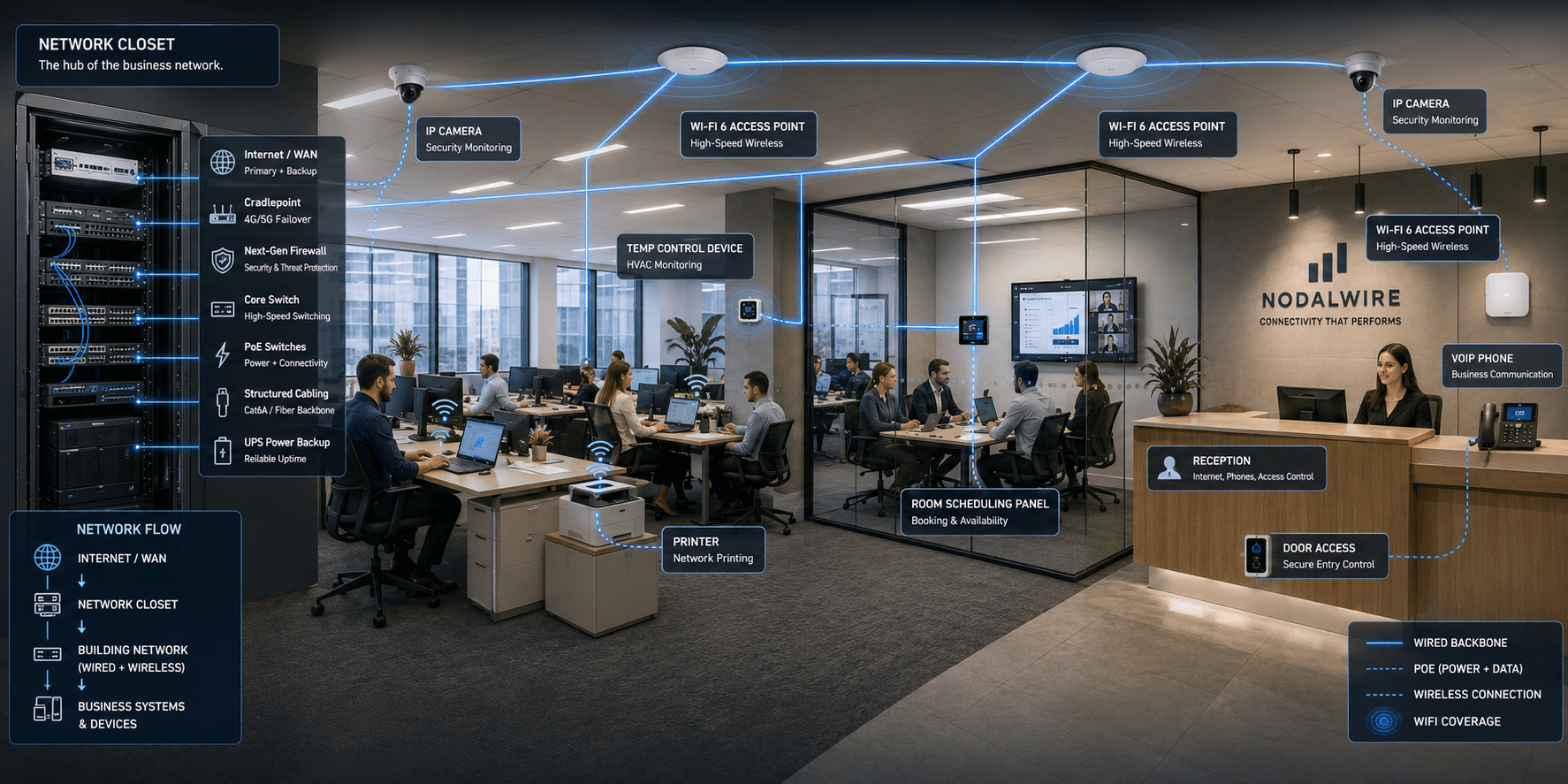
Your internet, wired network, Wi-Fi, applications, cameras, IoT devices, and business systems all depend on the same infrastructure. We design them as one coordinated network, built around how your business operates today and where it needs to grow.
What Actually Goes Wrong
Growth isn’t the problem. Unplanned growth is.
Enterprise infrastructure needs an architecture that evolves with the business.
Clean network
Business grows
More Wi-Fi and devices
Cloud, IoT and cameras
Additional sites
Architecture complexity
Four problem areas
Where We Work
An office, retail location, restaurant, warehouse, or multi-site operation may use many of the same technologies, but what matters most is different in each environment. We design around the systems, users, and services the business depends on most.
Cloud applications, collaboration, voice, Wi-Fi, cameras, guest access, and connected devices all depend on the same network. We design the LAN, WAN, and wireless environment so they remain reliable as the organization grows.
What runs here
Network foundation
LAN · WAN · Wi-Fi · Security · Segmentation · Resilience
What must stay online?
Cloud applications and voice & collaboration
How We Design
Before selecting switches, firewalls, access points, or circuits, we determine what needs to connect, how traffic should flow, what must remain available, and how the network needs to grow.
01
Users, applications, devices, locations, critical services, and business dependencies.
02
LAN, WAN, Wi-Fi, segmentation, security boundaries, connectivity, and resilience.
03
Capacity, uplinks, PoE, addressing, routing, equipment requirements, and redundancy.
04
Documentation, monitoring, migration, troubleshooting, expansion, and lifecycle planning.
Business Requirements Network Architecture Engineering Operations
Scope of Work
01
Core, distribution, access switching, Ethernet, fiber uplinks, and network segmentation.
02
IP addressing, routing, internet connectivity, primary and backup circuits, VPN, SD-WAN, and multi-site connectivity.
03
Firewall integration, guest networks, IoT, cameras, voice, management, and operational network separation.
04
MDF/IDF architecture, racks, PoE planning, structured cabling strategy, fiber backbone, and network power considerations.
05
Access-point connectivity, PoE capacity, switching readiness, VLAN integration, and coordination with the Wi-Fi design.
Explore Wi-Fi Design06
Network diagrams, device inventory, circuit documentation, migration planning, monitoring readiness, refresh planning, and multi-site standards.
Network infrastructure planning and engineering. Electrical contracting is outside our scope.
Common Questions
Yes. We can assess an existing network, identify architectural or capacity issues, and develop recommendations for modernization, expansion, or migration. We also design new networks from the ground up.
Yes. We start with the technical and operational requirements, then evaluate equipment and technologies that fit the architecture rather than designing around a predetermined vendor.
Yes. LAN, WAN, switching, routing, Wi-Fi, and supporting infrastructure are considered together so the wired and wireless environments operate as one network.
Yes. We can independently review proposed architectures, capacity, resilience, segmentation, equipment requirements, and documentation before implementation.
Yes. We can develop repeatable architecture, addressing, segmentation, equipment, documentation, and deployment standards while accounting for differences between individual sites.
Yes. Resilience is evaluated across critical network paths, including circuits, network equipment, uplinks, power dependencies, and connectivity between locations.
Yes. Depending on the project, deliverables can include network diagrams, IP and VLAN plans, equipment inventories, circuit information, migration documentation, and as-designed records.
Implementation support depends on the project. NodalWire can provide engineering, implementation planning, commissioning support, and coordination with qualified installation partners where field installation is required.
No. Network architecture becomes important whenever an organization depends on reliable connectivity, whether that is a single office, warehouse, restaurant, retail location, operational facility, or a multi-site business.